How to Build a Funnel-Based Digital Marketing Strategy
In today’s competitive digital landscape, growth doesn’t come from isolated campaigns—it comes from systems that scale. A funnel-based digital marketing strategy helps businesses attract the right audience, nurture prospects effectively, and convert them into loyal customers over time. Whether you’re a startup or an established Digital marketing company in Chennai, building a scalable funnel ensures consistent results without constantly increasing effort or spend.
Understanding Funnel-Based Digital Marketing
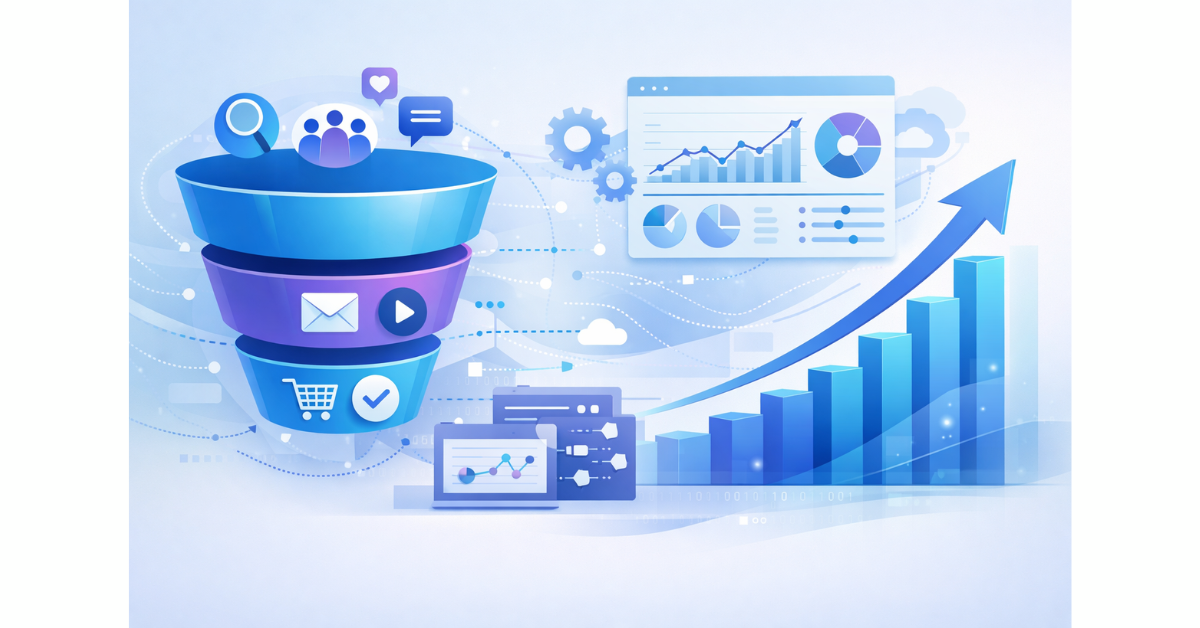
A marketing funnel represents the customer journey from first interaction to final conversion. It is typically divided into three stages: awareness, consideration, and conversion. Each stage requires different messaging, channels, and content formats.
A scalable funnel goes beyond basic structure. It uses automation, data, and repeatable processes so growth doesn’t rely solely on manual effort. The goal is to guide users seamlessly from discovery to decision while maintaining efficiency as volume increases.
Step 1: Define Clear Funnel Stages and Goals
Scalability starts with clarity. Each funnel stage should have a clearly defined objective:
- Awareness: Attract and educate potential customers
- Consideration: Build trust and demonstrate value
- Conversion: Drive action and close sales
Without defined goals, marketing efforts become scattered. Assign measurable KPIs to each stage, such as traffic quality for awareness, engagement rates for consideration, and conversion rates for the bottom of the funnel. These benchmarks make it easier to optimise and scale over time.
Step 2: Align Content With Search and User Intent
Content is the engine of a funnel-based strategy. However, scalable growth depends on how well content aligns with user intent.
Top-of-funnel content should focus on problem awareness and education. Blogs, videos, and social posts that answer common questions help attract qualified users. Middle-of-funnel content should address comparisons, solutions, and proof points such as case studies or in-depth guides. Bottom-of-funnel content must reduce friction through testimonials, landing pages, and clear value propositions.
When content is mapped correctly to intent, it continues to perform long after publication, supporting scalability without constant recreation.
Step 3: Build a Strong Traffic Foundation
A scalable funnel requires traffic sources that grow sustainably. Organic search, social media, and email marketing provide compounding returns over time, unlike channels that depend entirely on increasing budgets.
Search engine optimisation plays a critical role here. By targeting intent-driven keywords and creating evergreen content, businesses can generate consistent top-of-funnel traffic. Social media amplifies reach and supports engagement, while email nurtures leads deeper into the funnel.
Many brands struggle with growth because they rely too heavily on a single channel. A balanced traffic mix protects scalability and reduces risk.
Step 4: Use Automation to Support Growth
Automation is essential for scaling a funnel without increasing workload. Marketing automation tools allow businesses to nurture leads, segment audiences, and personalise messaging at scale.
Email workflows, lead scoring, and behavioural triggers help move users through the funnel automatically based on their actions. This ensures timely communication without manual intervention. For example, a user who downloads a guide can automatically receive follow-up content aligned with their interests.
A well-automated funnel enables a Digital marketing company to manage thousands of leads with the same efficiency as hundreds.
Step 5: Optimise Conversion Points Continuously
Scalability doesn’t mean set-and-forget. Every stage of the funnel should be continuously optimised for performance.
Landing pages should be tested for layout, messaging, and call-to-action placement. Forms should collect only essential information to reduce friction. Checkout or enquiry processes should be streamlined to minimise drop-offs.
Small improvements at key conversion points can significantly increase overall funnel efficiency. When conversion rates improve, the same amount of traffic produces higher returns—one of the core principles of scalable growth.
Step 6: Leverage Data for Smarter Decisions
A scalable funnel relies on data, not assumptions. Analytics help identify where users drop off, which channels perform best, and which content drives conversions.
Tracking tools should be set up to measure funnel performance end-to-end. This includes traffic sources, engagement metrics, lead quality, and revenue attribution. Data-driven insights allow marketers to double down on what works and eliminate inefficiencies.
As the funnel grows, data becomes even more valuable. It ensures scaling decisions are informed, controlled, and predictable.
Step 7: Create Systems, Not Campaigns
One of the biggest mistakes businesses make is focusing on one-off campaigns instead of repeatable systems. Scalable funnel-based marketing is built on frameworks that can be reused, refined, and expanded.
This includes content templates, automation workflows, audience segments, and reporting structures. When systems are in place, launching new products, entering new markets, or increasing budgets becomes far easier and less risky.
The focus shifts from constant execution to strategic optimisation.
Final Thoughts
Building a scalable funnel-based digital marketing strategy requires structure, intent alignment, automation, and continuous optimisation. When each stage of the funnel works together, growth becomes predictable rather than reactive. Businesses that invest in long-term systems instead of short-term tactics position themselves for sustained success. For any SEO company in Chennai aiming to grow efficiently, a scalable funnel is not just an advantage—it’s a necessity.
Related Post

G 1 Test Near Me London | Certified Test Guidance
Searching for G 1 Test Near Me London usually means one simple thing. You want…