

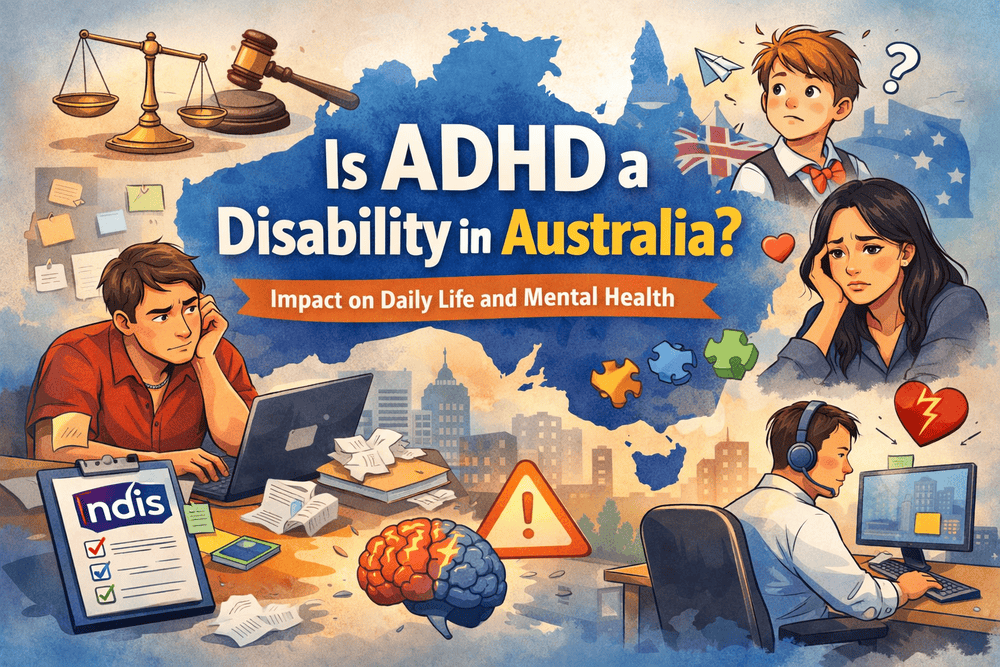
Attention Deficit Hyperactivity Disorder (ADHD) is often misunderstood, especially when it comes to how it affects adults and whether it is recognized as a disability. Many Australians living with ADHD struggle not only with symptoms such as inattention or impulsivity, but also with workplace challenges, academic barriers, and mental health concerns. This leads to an important and frequently searched question: Is ADHD a Disability in Australia?
In this article, we explore how ADHD is defined under Australian law, how it impacts daily life and mental health, and what support options may be available. Understanding these factors can help individuals, families, and employers create more inclusive and supportive environments.
ADHD is a neurodevelopmental condition that affects how the brain regulates attention, behaviour, and emotional responses. It typically begins in childhood but often continues into adolescence and adulthood.
Common symptoms include:
ADHD presents differently in each person. Some individuals may primarily struggle with inattention, while others experience hyperactivity or impulsive behaviour. Many people experience a combination of symptoms that interfere with everyday functioning.
The question Is ADHD a Disability in Australia does not have a simple yes or no answer. Legally, ADHD is not automatically classified as a disability, but it can be recognized as one depending on how significantly it impacts a person’s daily life.
Under Australia’s Disability Discrimination Act 1992 (DDA), a disability includes:
Because ADHD is a neurological and neurodevelopmental condition, it may fall under this definition if symptoms substantially limit functional capacity. This means individuals with ADHD may be protected from discrimination in areas such as:
However, eligibility is assessed on a case-by-case basis, not by diagnosis alone.
Many people also ask whether ADHD qualifies for support through the NDIS. In most cases, ADHD on its own does not meet NDIS eligibility criteria.
The NDIS focuses on:
ADHD is often considered manageable through behavioural therapy, psychological support, or medication. However, some individuals with severe ADHD, particularly when combined with other conditions such as autism, anxiety disorders, or learning disabilities, may qualify.
A formal functional assessment is usually required to determine eligibility.
Regardless of legal classification, ADHD can significantly affect daily functioning. These impacts often go unnoticed or are misinterpreted as laziness or lack of motivation.
Children, teenagers, and adults with ADHD may struggle in educational settings due to:
Without appropriate support, students with ADHD may experience lower self-esteem and disengagement from learning.
Adults with ADHD often face unique challenges at work, including:
While many individuals with ADHD are creative and innovative thinkers, they may require reasonable adjustments such as flexible schedules or structured workflows to perform at their best.
One of the most significant but overlooked aspects of ADHD is its impact on mental health. Living with unmanaged ADHD can increase the risk of developing additional psychological conditions.
Constantly trying to keep up with expectations can lead to chronic stress and anxiety. People with ADHD may feel overwhelmed by daily responsibilities or fear making mistakes.
Repeated experiences of failure, criticism, or misunderstanding can contribute to low self-esteem and depression. Adults diagnosed later in life may struggle with grief over missed opportunities or years of undiagnosed symptoms.
ADHD is also associated with difficulty regulating emotions. This can result in:
These challenges can strain relationships and further impact mental wellbeing.
ADHD affects more than work and study—it can influence personal relationships as well.
Common difficulties include:
These behaviours are often unintentional but may be misinterpreted by others, leading to conflict or isolation.
Despite growing awareness, ADHD is still surrounded by stigma. Many people believe it is “not serious” or something individuals should simply outgrow.
This misunderstanding can:
Recognizing ADHD as a legitimate neurological condition is essential for improving access to support and reducing discrimination.
Even if ADHD is not always classified as a disability, various support options are available across Australia.
Management plans may include:
Early diagnosis and appropriate intervention can significantly improve quality of life.
Students with ADHD may be eligible for reasonable adjustments, such as:
These adjustments aim to level the playing field rather than provide an unfair advantage.
Under Australian law, employees with ADHD may request reasonable workplace adjustments if their condition meets the definition of a disability.
Examples include:
Employers are encouraged to foster inclusive environments that support neurodiversity.
Returning to the key question Is ADHD a Disability in Australia the answer depends on functional impact, not just diagnosis.
ADHD may be considered a disability when:
Professional assessments play a crucial role in determining this.
A formal assessment can help individuals:
Access to qualified professionals and evidence-based care is essential for long-term wellbeing, and platforms like Expertminds aim to improve access to mental health support through modern, flexible care options.
Whether or not ADHD is formally classified as a disability, its impact on daily life and mental health is real. Recognizing ADHD as a legitimate neurological condition helps reduce stigma, improve access to care, and promote understanding in schools, workplaces, and communities.
For many Australians, the question is not simply Is ADHD a Disability in Australia, but rather how society can better support those living with ADHD to thrive, not just cope.

