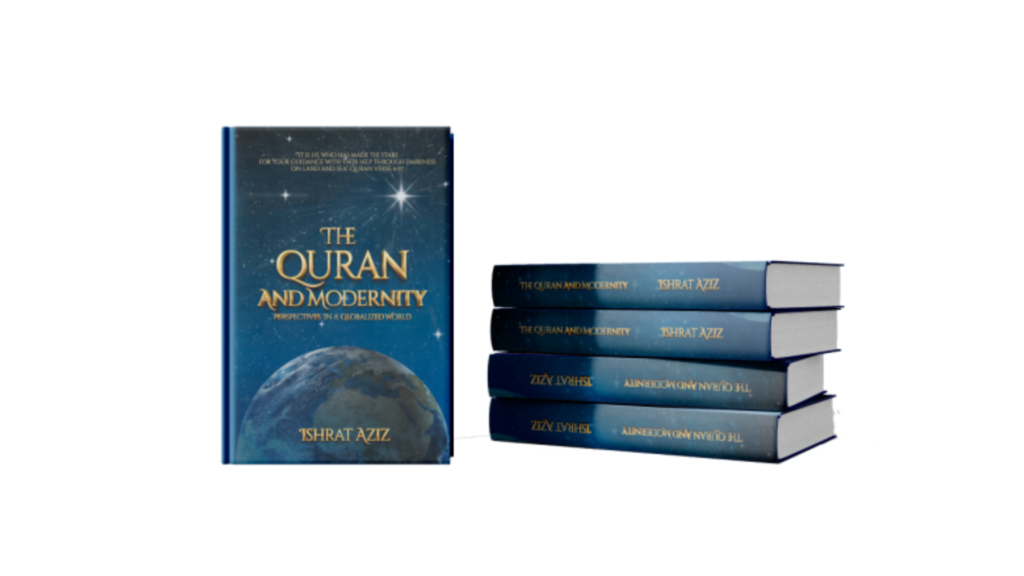
Modernity and Islam seem to be antagonistic. However, Ishrat Aziz shows that they can co-exist. From his early years as a university teacher to his role as a notable diplomat, Aziz saw cultures in many parts of the world. He observed that even the differences do not change human nature. Hopes, fears, and aspirations are shared by people all around. This makes it necessary to interpret Islam within the framework of modernity. Aziz’s work bridges this gap. In his book, he explicates the application of Islamic teachings to contemporary issues. In fact, his traveling is characterized by a search for proportions.
Ishrat Aziz was an educator who started working at the university in 1961. He at once talked to young minds. Therefore, became very curious about human behavior. He later became part of the Indian Foreign Service in the year 1964. This was a breakthrough in his perception of cultures around the world. He was deployed in Iraq, Morocco, Lebanon, and the United States. Subsequently made an ambassador to the UAE, Saudi Arabia, Brazil, and Tunisia. He saw different societies as a diplomat. Thus, he was aware that external differences tend to cover similar human requirements.
During his engagement in diplomacy, Aziz experienced peculiarities. He has witnessed the politically complex and socially resilient situation in Iraq. In the meantime, in Morocco and Lebanon he experienced how culture influenced society. He also encountered modernity in the United States. Based on the world trends, he had conclude that societies have common problems. In what ways can different individuals coexist? What can systems do to be inclusive of the interests of everyone? These were the questions that became the central thought for him. Hence, his interest in Islam and modernity was ignite by his profession.
According to Aziz, the development of intelligence is like chasing a moving horizon. Every response will result in new questions. Therefore, the learning process is never-ending. This was his lesson on Modernity and Islam. He studied the Sunnah and the Quran with an open mind. He was concerned with human welfare and real-life. In this manner, he attached faith to the normal lives. To give an example, he studied social rules, morals, and politics using Quranic directives. In addition, he concentrated on the importance of context. In the absence of context, interpretations would not match contemporary challenges. Thus, Aziz invites readers to be critical.
According to Aziz, it is observe that modernity does not contradict Islam. They are, instead, complementary to each other. To exemplify, educational and other technological developments are progressive to society, whereas morality is guided by Islamic values. On the same note, globalization unites societies, and Quran advocates equality and fairness. Therefore, the contemporary tools back up moral objectives. Furthermore, Aziz observes that Islam needs to be reform towards modernity and not compromised. One has to maintain the best values and, at the same time, be accommodating to change. The changeover is gradual so that continuity is maintain and relevance is achieve.
The book The Quran and Modernity by Aziz dwells in detail on this integration. It analyses the manner in which the Quranic teachings touch on modern issues. Indicatively, he writes on social justice, human rights, and communal harmony. Shifting to classical connotations, he makes corresponding principles to the present situations. Moreover, he gives clear-cut examples. In illustration, examples of Quranic directives can be seen in ethical business, fair governance, and conflict resolution. Relating to the past and the contemporary problems, Aziz provides answers to life in the contemporary world. His approach has been combining with theory and practice. Besides, he challenges readers to reason.
The concept of human nature is at the center of Aziz’s thinking. He asserts that all individuals across the globe share common aspirations and hopes, as well as fears. This is an important realization to ensure coexistence. Islamic teachings should therefore respond to the human realities and not to idealistic concepts. An example is that cooperation, tolerance, and compassion are eternal values. Moreover, they are quite close to contemporary societies. It takes hard work to shift theory to practice. However, Aziz stresses that the study of human behavior improves harmony in society. In such a way, Islam modernity coincides whereby the ethical teachings are relevant to the current problems.
Education has also been a key factor in the harmonization of Islam modernity. Aziz emphasizes a smart practice. The switching of rote learning to critical thinking enables people. Likewise, tolerance is foster by learning about different cultures. Moreover, education promotes the concept of using Quranic teachings in contemporary issues. Social justice, social ethics, and environmental protection are some of the examples of issues benefiting from informed interpretation. Subsequently, education enhances abstract knowledge into practice. Aziz emphasizes that lifelong learning enhances faith and current knowledge at the same time.
Aziz offers practical advice to Muslims in contemporary times. He promotes moral decision-making, equity in business, and equity in government. The use of personal morality as a link to societal responsibility is bound to Quranic values. Also, he accentuates the importance of dialogue and compromise. These can assist different social groups to live together in harmony. As an example, the ethical leadership based on faith is an advantage in modern workplaces. In addition, the technological advances favor social welfare provided that they are in tandem with ethical principles. Consequently, modernity combined with the Quran makes a harmonious life.
One of the lessons of Aziz is the ability to reconcile change with tradition. It may be confusing to change very fast. On the other hand, change should not be met with total resistance because it is counterproductive to development. Thus, Islam modernity must be negotiated. Aziz illustrates how universal values fit in changing realities. As one instance, digital communication promotes ethical responsibility as it promotes a global dialogue. On the same note, the Quranic stewardship of resources is associated with sustainable development. That is to say, modernity and Islam do not have to clash. Rather, they support one another with deliberate interaction.
Through understanding, Modernity and Islam can exist together. Ishrat Aziz illustrates this through his work and life. His experiences as a diplomat depict that human nature is constant. Therefore, the Islamic teachings in a considerate manner address the current challenges. His book, The Quran and Modernity, is an interlude between tradition and advancement. Aziz offers a guide to a harmonious living by educating and promoting morals and social good. Finally, his knowledge demonstrates that the modernity of Islam is not a contradiction. Rather, it is a balance between religion and transformation.

