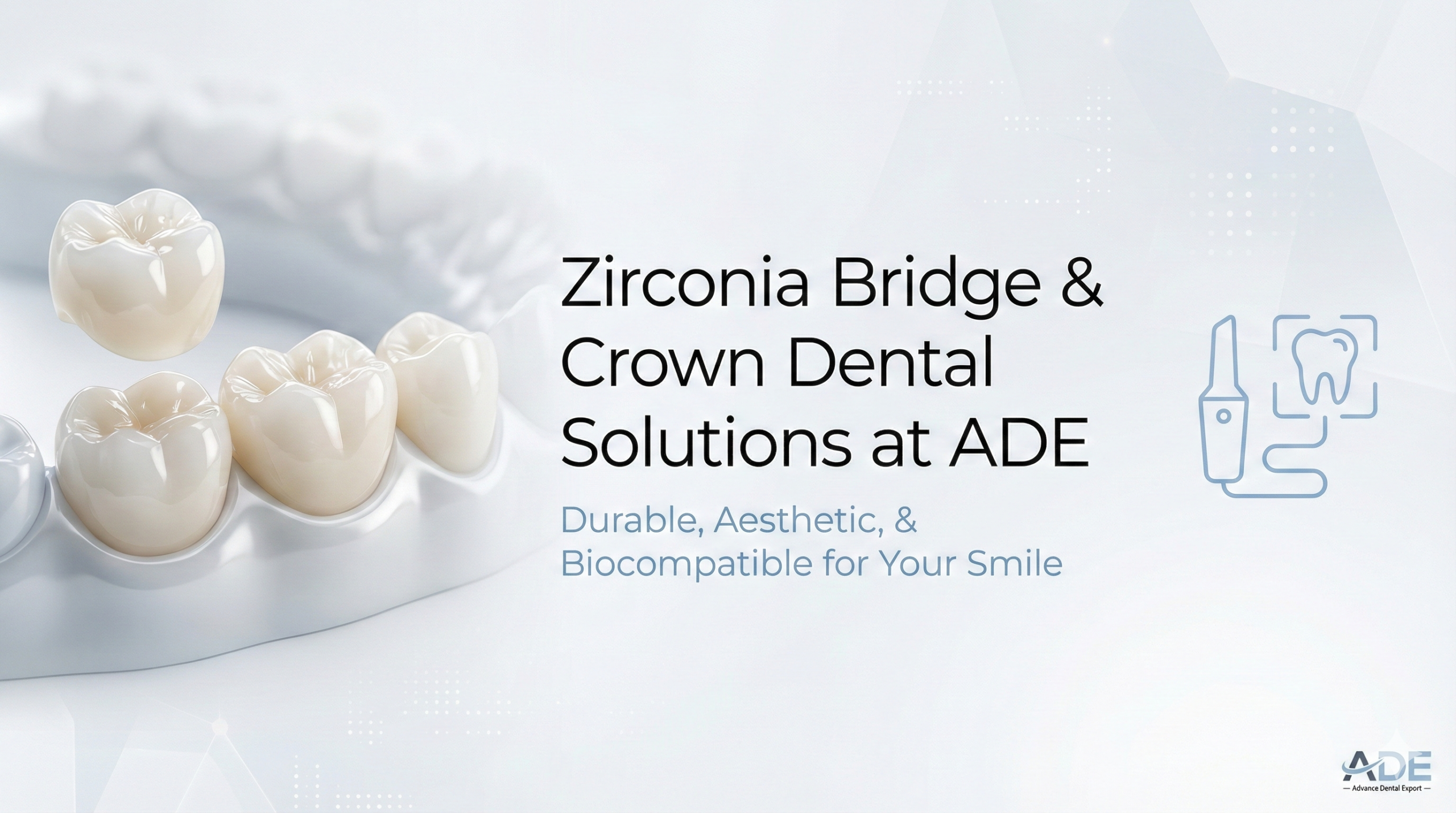
In modern restorative dentistry, zirconia crowns and bridges have redefined expectations for strength, aesthetics, and long-term clinical success. As digital workflows, material science, and patient demands continue to evolve, zirconia has emerged as one of the most reliable solutions for both anterior and posterior restorations.
At Advance Dental Export, zirconia restorations are not treated as a commodity, but as a precision-engineered clinical solution. This guide is designed to help dentists, clinic owners, and decision-makers clearly understand the zirconia crowns and bridges solution—from material science to indications, advantages, limitations, and laboratory considerations.
Zirconia (zirconium dioxide) is a high-strength ceramic originally developed for aerospace and orthopedic applications. Its introduction into dentistry transformed restorative options by combining exceptional mechanical strength with biocompatibility and evolving aesthetics.
Modern dental zirconia is no longer a single material category. It is available in multiple formulations designed for different clinical needs:
3Y-TZP (High-strength zirconia) – Best for posterior crowns and long-span bridges
4Y zirconia – Balanced strength and translucency
5Y zirconia (High-translucency zirconia) – Optimized for anterior restorations
This material diversity allows restorations to be customized based on occlusal load, esthetic zone, and preparation design.
Zirconia exhibits flexural strength significantly higher than traditional ceramics. This makes it ideal for:
Posterior crowns
Multi-unit bridges
Implant-supported restorations
Its resistance to chipping and cracking ensures predictable long-term outcomes.
Earlier zirconia restorations were known for opacity. Today’s multilayered and high-translucency zirconia offers:
Natural light transmission
Gradual color transitions from cervical to incisal
Reduced need for veneering porcelain
This enables monolithic restorations with excellent esthetics and minimal risk of veneer chipping.
Zirconia is highly biocompatible:
No metal allergies
Minimal plaque accumulation
Favorable soft tissue response
Patients benefit from restorations that are both comfortable and tissue-friendly.
Compared to porcelain-fused-to-metal (PFM) restorations, zirconia allows:
Reduced tooth reduction
Preservation of natural tooth structure
Strong margins even with thin designs
Zirconia crowns are suitable for a wide range of cases:
Posterior single-unit restorations
Bruxism cases requiring high durability
Implant-supported crowns
Anterior crowns using high-translucency zirconia
At Advance Dental Export, crown designs are optimized through CAD/CAM systems to ensure precise marginal fit and proper occlusal anatomy.
Zirconia bridges excel in cases where mechanical demands are high. Key advantages include:
High load-bearing capacity
Stability in multi-unit frameworks
Reduced framework fracture risk
They are particularly effective for:
Short- and long-span bridges
Implant bridges
Full-arch restorations
Careful connector design, material selection, and sintering protocols are critical to bridge longevity—an area where laboratory expertise plays a decisive role.
Zirconia requires specific cementation protocols:
Resin cements for maximum retention
Proper surface treatment (air abrasion)
Clean bonding surfaces free from contamination
Correct cement selection significantly impacts restoration longevity and retention.
The clinical success of zirconia restorations depends heavily on laboratory execution. At Advance Dental Export, the workflow emphasizes:
Advanced CAD/CAM milling technology
Strict quality control at each production stage
Shade accuracy using multilayer zirconia blanks
Anatomical contouring for functional occlusion
Every restoration is fabricated with attention to marginal accuracy, emergence profile, and occlusal harmony.
| Feature | Zirconia | PFM | Lithium Disilicate |
|---|---|---|---|
| Strength | Very High | High | Moderate |
| Aesthetics | High (modern zirconia) | Moderate | Very High |
| Metal-Free | Yes | No | Yes |
| Chipping Risk | Low (monolithic) | Moderate | Moderate |
| Longevity | Excellent | Good | Good |
Zirconia offers the best balance of durability and esthetics for many restorative scenarios.
Ongoing advancements continue to enhance zirconia’s performance:
Higher translucency without compromising strength
AI-driven design for improved occlusion
Full-digital workflows for faster turnaround
Zirconia is no longer just a “strong” material—it is a complete restorative solution.
Zirconia crowns and bridges represent a cornerstone of contemporary restorative dentistry. When designed and fabricated correctly, they provide predictable, durable, and esthetically pleasing outcomes for both dentists and patients.
At Advance Dental Export, the focus remains on delivering zirconia restorations that meet clinical demands while maintaining consistency, accuracy, and quality. Through advanced technology and material expertise, zirconia continues to set new standards in restorative care.